
Embodied carbon is moving up the agenda: what our joint webinar with FIS revealed
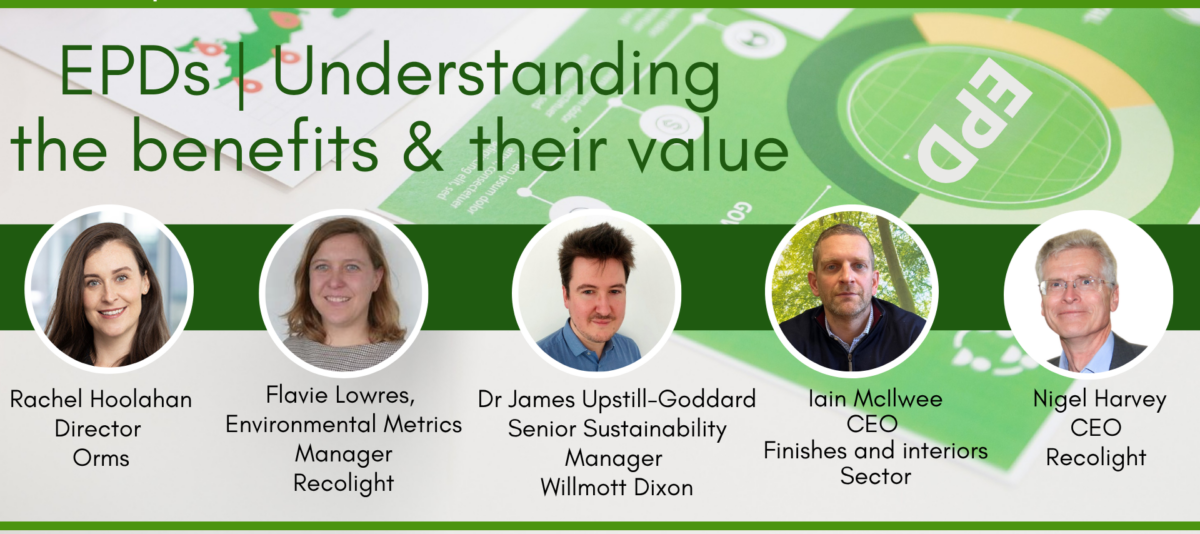
Recolight recently teamed up with the Finishes and Interiors Sector (FIS) for a joint webinar exploring one of the built environment’s fastest-moving conversations: how the industry accounts for the carbon locked into the products and materials that go into buildings, not just the energy used to run them once complete.
Why embodied carbon can no longer sit in the background
For years, the industry’s main focus has been operational carbon, the emissions produced by heating, cooling, lighting and powering buildings. But as buildings become more efficient and the UK grid continues to decarbonise, that balance is shifting.
Flavie Lowres, who holds a dual Sustainability Champion role across Recolight and FIS, framed it like this during the session:
“As buildings become more energy efficient, the grid decarbonises, and buildings become less dependent on gas, the proportion of operational and embodied carbon will change. Therefore, it is important that we start to look at embodied carbon emissions as well.”
Embodied carbon captures the emissions generated across a product’s entire life-cycle, from raw material extraction and manufacture, through transport and installation, to maintenance and eventual disposal. For an organisation like Recolight, working at the intersection of lighting, recycling and producer responsibility, this whole life-cycle view is exactly where our focus already sits.
EPDs: giving embodied carbon a common language
A recurring theme of the webinar was the role of the Environmental Product Declaration (EPD) as the mechanism that makes embodied carbon measurable and comparable. Flavie described an EPD as an independently verified, registered document, built on a Life Cycle Assessment, that sets out transparent, comparable environmental data across a product’s life.
Importantly, she was clear that this doesn’t mean every manufacturer needs an EPD for every single product variant:
“You don’t have to worry about doing one EPD for every single permutation of your products.”
Grouping products into families and applying recognised scaling methodologies can deliver meaningful, credible environmental data without manufacturers having to absorb disproportionate cost; a point that matters for smaller and mid-sized suppliers weighing up where to invest first.
Carbon is now a budget line, not an afterthought
Architect Rachel Hoolahan. Associate Director at Orms gave a striking insight into how far embodied carbon thinking has already travelled into everyday design practice. At her practice, carbon is treated with the same discipline as project finances:
“When we start with carbon, we’re thinking about it from the very start of any project.”
She described a base carbon budget alongside a developing budget, used to identify and target reductions in key areas as a project progresses. By the end of the discussion, she confirmed just how embedded this approach has become:
“All of our projects, no matter how big or small, have a carbon budget at this point.”
Moving from claims to evidence
For contractors, the appetite for verified environmental data is intensifying. James Upstill-Goddard of Willmott Dixon described a clear shift away from generic sustainability marketing:
“There’s been a shift from claims to evidence.”
EPDs, he explained, allow contractors to move away from broad assumptions about how a product or building will perform, and towards product-specific evidence. Crucially, he argued their value goes beyond simply reporting a number:
“EPDs help us move from just reporting carbon to carbon reduction; actually being able to do something with it.”
Procurement frameworks are accelerating demand
Public sector procurement is proving to be one of the biggest drivers of change. James pointed to the Department for Education’s latest framework as a significant marker of where the industry is heading, noting that it expects 85% by mass of all materials and products used in a school to have an EPD available.
He didn’t underplay the scale of that challenge, describing it as a huge undertaking, while acknowledging it as a clear signal of direction of travel. As more public and private clients adopt similar expectations, manufacturers who can already produce verified environmental data will find themselves better placed to compete for work.
Why this matters for fit-out and interiors and for Recolight
The Q&A session brought the conversation back to practical relevance for the fit-out and interiors sector, where product cycles are notably short. Ian McIlwee of FIS made the point plainly:
“We fit out such a fast cycle. Every five, every seven years, we’re stripping stuff out. We’ve got to be thinking longer term about the decisions that we’re making.”
That short replacement cycle is precisely why the work Recolight does, supporting the recycling and reuse of lighting equipment at end of life, sits so closely alongside this embodied carbon conversation. Frequent refits generate frequent waste streams, and understanding the full life-cycle impact of products, lighting included, is central to reducing that impact.
At the same time, speakers were careful not to present EPDs as a gatekeeper for innovation. Rachel cautioned against ruling out products purely because they lack an EPD:
“The EPD is not the be all and end all.”
While EPDs offer the best available framework today, she was equally clear that this shouldn’t come at the cost of new ideas: “I certainly don’t want to stifle innovation.” James echoed the sentiment, agreeing that consistency matters, but that the underlying goal is to understand real-world impacts and support better decisions as reliably as possible.
Beyond carbon: ecology and circularity
The conversation also looked ahead to what comes after carbon. Rachel suggested that the industry’s environmental focus has, for the past few years, been narrowly fixed on carbon alone:
“We’ve been in a carbon-blinkered world for the past couple of years.”
She pointed to growing interest in wider ecological impacts, water consumption, pollution and biodiversity among them, as the next frontier of environmental assessment.
Circularity featured strongly too, with Rachel encouraging manufacturers to look beyond one-off product sales towards reuse and refurbishment models:
“Circularity is a huge growing piece.”
This is territory Recolight knows well. Extending the life of lighting products, and ensuring materials are recovered and reused at end of life, is a practical expression of the same circularity principle being discussed at a whole-building scale.
The direction of travel
The clear takeaway from the webinar is that embodied carbon is fast becoming a metric that sits alongside cost, programme and quality, not a niche add-on. Public sector frameworks, client expectations and emerging standards are all pulling the industry towards greater transparency.
For manufacturers and suppliers, robust environmental data is increasingly becoming a condition of market access. For designers and contractors, it’s becoming essential to informed decision-making. As James put it:
“The real value in EPDs is when the important decisions are made.”
For Recolight and our members and partners across the lighting and interiors supply chain, the message is clear: now is the time to engage with embodied carbon, understand how EPDs work, and prepare for a market where verified environmental performance is expected as standard.
This webinar was jointly hosted by Recolight and the Finishes and Interiors Sector (FIS).
