
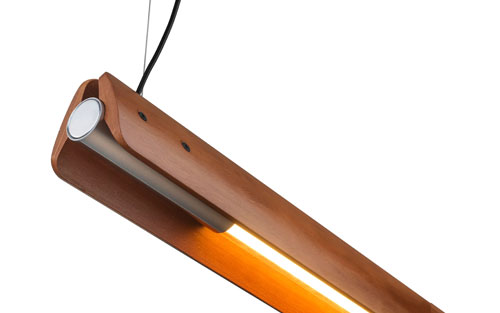
Italian lighting manufacturer Flos has reintroduced a historic timber-based design originally conceived in 1963, bringing one of its early experiments in directional wooden lighting back into contemporary production with updated LED technology and improved manufacturing precision.
The relaunch of the Seki-Han by Tobia Scarpa reflects a broader industry trend toward revisiting early post-war lighting concepts through the lens of current sustainability expectations. reflects a broader industry trend toward revisiting early post-war lighting concepts through the lens of current sustainability expectations. The original design, created during a period when timber was occasionally used in experimental architectural lighting, has been re-engineered to meet modern safety standards, energy efficiency requirements, and material traceability expectations.
The updated version retains its defining wooden construction, using carefully selected ash components shaped into adjustable slats that allow users to control beam direction and intensity through physical manipulation of the timber elements. This mechanical approach eliminates the need for additional optical accessories, relying instead on geometry and material positioning to shape light distribution.
Flos has refined the production process to improve consistency while preserving the tactile quality of the original concept. CNC machining and modern finishing techniques have replaced earlier handcrafted variability, enabling tighter tolerances and more predictable optical performance while maintaining the visual warmth associated with natural wood.
The relaunch also aligns with increasing demand for low-impact materials in architectural lighting, particularly in commercial interiors where designers are seeking alternatives to aluminium-heavy systems. While the fixture is not positioned as a fully circular product, its use of responsibly sourced timber and reduced reliance on mixed-material assemblies places it within a growing category of partially bio-based luminaires entering mainstream specification.
Industry observers note that the revival of mid-century timber lighting concepts signals renewed interest in material-led design logic, where wood is used not only as a decorative surface but as an active optical component in the lighting system itself. In this context, Flos’s reissued 1963 design serves as both a historical reference and a contemporary response to evolving sustainability pressures in architectural lighting markets.
• Learn more sustainable lighting at Circular Lighting Live 2026, Recolight’s flagship conference and exhibition, which takes place on Thursday 8 October 2026 at the Minster Building in the City of London. Free to specifiers, Circular Lighting Live 2025 will feature leading experts, specifiers and policy makers who will share their insights into forthcoming standards and legislation, emerging technologies and new business models. More info: www.circularlighting.live
