
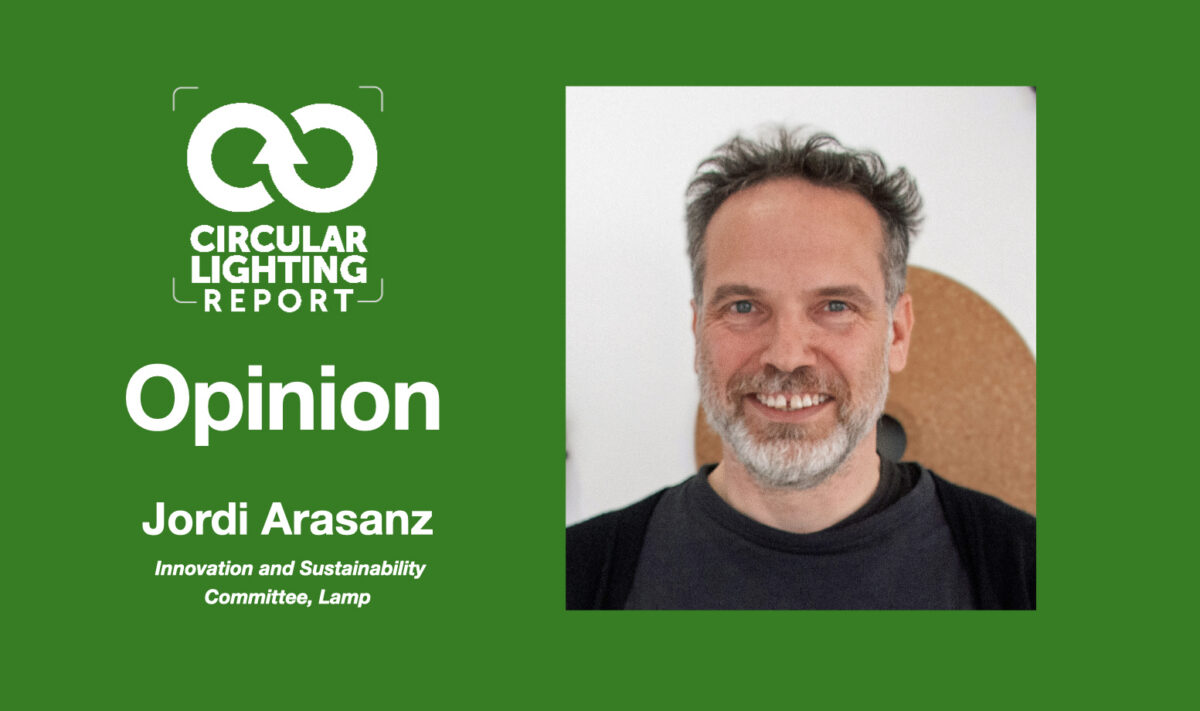
Jordi Arasanz, technical director and member of the Innovation and Sustainability Committee at Lamp, calls for a mindset change in the lighting industry
Over the past decades, technological innovation in lighting—from the shift to LED technology to the digitalisation of control systems—has enabled remarkable advances in energy efficiency. However, this progress has often been accompanied by the premature replacement of functional luminaires, generating significant volumes of waste and unnecessary loss of material resources.
Today, in the face of decarbonisation challenges and raw material scarcity, it’s essential to adopt a circular perspective that instead prioritises upgrading and intelligent maintenance over systematic replacement.
The circular economy applied to lighting represents a paradigm shift. It means extending the useful life of what already exists, integrating innovation systemically, and designing with the future evolution of spaces in mind.
Lighting sits at the intersection of architecture, engineering, and industry. Every installed luminaire forms part of a building’s architectural language while also functioning as a technical system that can be refurbished, adapted, or digitised.
Understanding it as an evolving element—rather than a limited-lifespan product—opens new opportunities to reduce environmental impact without compromising lighting quality or user comfort.
This approach requires closer collaboration between manufacturers, specifiers, and building managers to develop solutions designed for upgradability.
Designing for maintenance and adaptation becomes a key tool in advancing toward more responsible construction models.
At Lamp, we have spent years working to decouple technological progress from waste generation. This vision translates into projects that integrate ecodesign, efficiency and circularity criteria throughout the entire product life cycle.
One example is CircuLight, a service which enables the upgrading of already installed luminaires through adapted technological modules—extending their lifespan and significantly reducing their environmental impact.
From our experience, real progress towards more sustainable architectural lighting is built on two complementary lines of action:
• Upgrading what already exists. Services such as CircuLight demonstrate that it is possible to extend the lifespan of installed luminaires, avoiding replacement. Circulight projects have achieved annual energy savings of over 50 per cent, recovered kilometres of aluminium profiles, and reduced more than 300 tons of CO₂ equivalent.
• Ecodesign as a driver of innovation. At the same time, new developments incorporate circular design criteria that facilitate upgrading, disassembly and adaptation of luminaires throughout their life cycle.
In this context, innovation means anticipating change and designing products prepared for it.
Both approaches share the same goal: demonstrating that sustainability doesn’t limit innovation but rather guides it toward more durable, efficient solutions aligned with today’s challenges.
The challenge now is to broaden this perspective. If we’re capable of upgrading lighting systems instead of replacing them, why not apply the same principle to other building elements? The circular economy not only reduces environmental impact—it also fosters stronger relationships among industry stakeholders, promotes transparency, and compels us to design with the long term in mind.
As an industry, we have a responsibility to move from producing more to producing better, and to design solutions intended to be maintained, adapted and evolved. Lighting can—and should—be a visible example of this transformation: a way to move forward without destroying, to innovate without wasting.
• Jordi Arasanz, Technical Director and member of the Innovation and Sustainability Committee at Lamp.
Qualified in Industrial Drafting, with more than 20 years of experience. Member of various working groups at CICAT focused on Health and Wellbeing and on New Technological Trends applied to the lighting sector.
• Learn more sustainable lighting at Circular Lighting Live 2026, Recolight’s flagship conference and exhibition, which takes place on Thursday 8 October 2026 at the Minster Building in the City of London. Free to specifiers, Circular Lighting Live 2025 will feature leading experts, specifiers and policy makers who will share their insights into forthcoming standards and legislation, emerging technologies and new business models. More info: www.circularlighting.live
