
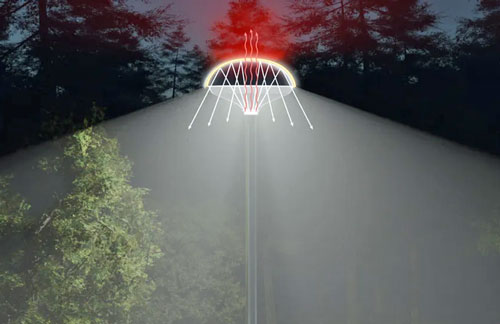
Scientists says that a new generation of nano optics has the power to dramatically reduce the carbon emissions of street lights.
A collaborative study between two universities in Saudi Arabia says that a material called nanoPE has the potential to revolutionise the sector.
The teams from King Abdullah University of Science and Technology (KAUST) and King Abdulaziz City for Science and Technology (KACST) estimate that by adopting this technology, the United States alone can reduce carbon dioxide emissions by more than one million metric tons.
NanoPE enhances the emission of thermal radiation from the surface of the LED to reduce the LED temperature. LEDs generate heat, which raises their temperature and risks damaging the LED electronics and shortening the LED’s lifespan. In fact, approximately 75 per cent of the input energy in LEDs is eventually lost as heat.
Study leader, KAUST Professor Qiaoqiang Gan, told the press: ‘LEDs are preferred light sources because of their superior efficiency and lifespan. But small enhancements can improve them even more, and that can make a big difference on sustainability because even small improvements have a big effect when used everywhere’.
He added that lighting is approximately 20 per cent of the world’s annual electricity consumption and contributes to nearly 6 per cent of global greenhouse gas emissions.
‘Our design significantly improves LED cooling while maintaining high illumination efficiency,’ said Dr. Hussam Qasem, general manager of the Future Energy Technologies Institute at KACST and contributor to the study ‘This makes it a promising solution for sustainable lighting in Saudi Arabia.’
Remarkably, streetlights coated with nanoPE are literally turned upside down so that they are directed towards the sky and away from the object to be illuminated.
The reason for this inversion is that NanoPE is designed so that infrared light, the light most responsible for thermal radiation, passes through it while visible light is reflected.
The study showed that more than 80 per cent of the infrared light emitted by LED streetlights coated with nanoPE passes through nanoPE and continues towards the sky.
In contrast, more than 95 per cent of the visible light emitted reflects off nanoPE and back to the ground, illuminating the area beneath.
It’s not clear if the remaining 5 per cent is emitted upwards, which could have implications for ‘Dark Sky’ policies which aim to eliminate upward light pollution.
NanoPE is based on polyethylene, the most widely produced plastic in the world.
To create a nanoplastic that reflects low wavelength light (visible light) but passes high wavelength light (infrared), the scientists carefully made pores as small as 30 nm – about 1000 times smaller than the thickness of a human hair – into the plastic as well as stretching and transforming it into a thinner sheet.
• Learn more about sustainable lighting at Circular Lighting Live 2026, Recolight’s flagship conference and exhibition, which takes place on Thursday 8 October 2026 at the Minster Building in the City of London. Free to specifiers, Circular Lighting Live 2026 will feature leading experts, specifiers and policy makers who will share their insights into forthcoming standards and legislation, emerging technologies and new business models. Search ‘Circular Lighting Live’
