
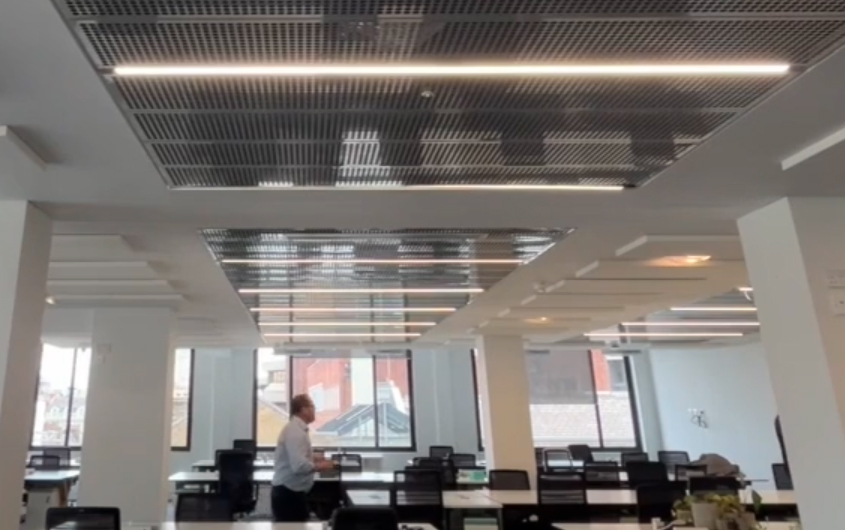
The luminaires and ceiling in a prestigious office are set to be removed and reused in a second location in the City of London.
In a major step forward for the circular economy in commercial fit-out, the Finished and Interiors Sector Project Reuse Scheme is supporting the reuse of high-quality LedLuk lights and ceiling tiles from Rathbone Place to Broadgate, two landmark London developments.
The initiative sees Ambit, part of the Workplace Futures Group, carefully strip out and recover bespoke SAS ceiling tiles and luminaires during its refurbishment works at Rathbone Place.
Hattie Emerson, project manager for Project Reuse, said: ‘This case study provides a transparent, real-world view of how reuse can be achieved safely, efficiently, and collaboratively across live projects, demonstrating how design, logistics, and sustainability can align across multiple organisations.’
Project Reuse is part of FIS’s wider sustainability mission, helping the fit-out sector transition towards circularity by encouraging the recovery and reuse of materials.
The initiative explores the practicalities of identifying, removing, preparing, and reusing materials such as ceiling tiles and luminaires, ensuring they meet safety, performance, and design standards.
Project Reuse recently won a prestigious Build Back Better Green Award in the 2025 lighting category.
The FIS is a trade association with over 600 members (manufacturers, distributors, contractors and installers) operating in the fit-out sector. Over 80 pre cent of the work of its members is delivering the renovation of existing buildings.
Buildings are typically refitted every five to seven years, with a trend to shortening commercial leases suggesting it is becoming more frequent in large cities, such as London.
This work generates large amounts of waste – some studies suggest 300 tonnes of waste to landfill daily – and vast amounts of carbon.
After four fit-outs, the embodied carbon per square metre is larger than the kgCO2eq/m2 of the structure.
It also requires large quantities of primary resource extraction.
To make things worse, when a tenant leaves, they are required to strip out the space and revert it back to the original Cat A installation, known as dilapidation. When it is re-let, the new tenants then strip out products from the Cat A fit out to install their final finishes.
Products like light fittings are often victims of this transition as there is little thought given to what is already in the space.
The FIS Sustainability Leadership Group started to explore the need and opportunity to re-use products from existing buildings into new projects, transferring ownership from business-to-business.
While there is an established market for products to be reused in the third sector such as social housing and schools, this is limited. The re-use of products is logistically challenging and has programme, risk and commercial considerations.
FIS Project Reuse is addressing this by looking at how we can standardise, normalise and industrialise re-use in the fit-out sector, making re-use ‘business as usual’.
By offering a storage solution combined with a logistics offer, FIS is facilitating the re-use of carefully selected products. Based on real-world experience of overcoming the obstacles, FIS will write standards and guidance that will be open-source, with all findings published.
Supporters of the scheme include Reusefully, Ambit-Moat, Lumybel, Blackstone Strip Out, Workplace Futures Group, tp Bennett, Space Interior Systems, SAS, Recolight, Overbury and BPC Interiors.
