
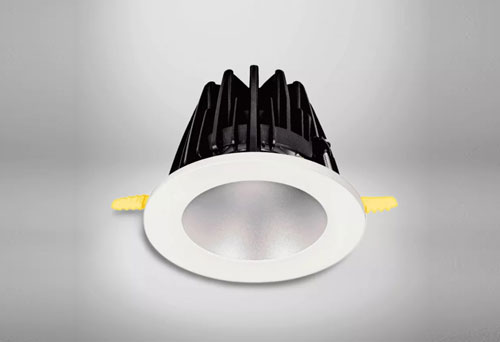
A downlighting from Lumenloop has scored a TM66 rating of 2.5, putting it in the excellent category.
The Eco 78 LED is a highly efficient lighting solution powered by a Philips LED module, designed to provide exceptional performance while prioritising sustainability.
With module efficacies reaching up to 192 lumens per watt, the downlight features a twist-and-lock bezel and a range of interchangeable accessories.
Its components can be easily disassembled, allowing for renewal, reuse, or recycling through remanufacturing, which aligns with modern environmental considerations.
It has a lifespan exceeding 50,000 hours (L80 / B10) and a low-glare design. It delivers up to 135 lumens per total circuit watt, contributing to increased energy efficiency while providing excellent light quality.
TM66, or ‘technical memorandum 66’, measures the circular performance of luminaire and was developed by Cibse’s Society of Light and Lighting.
The document won a prestigious Build Back Better Award on its publication on its publication in 2001 and was quickly adopted by the lighting industry.
Major lighting design practices and organisations are using the metric in their procurement and specification policies, and many manufacturers have rated their luminaires on the TM66 scale, which gives a number between 1 and 4 similar to a vehicle’s NCAP safety rating.
TM66 has two key tools These include CEAM-Make, a tool for manufacturers to complete which comprises 66 questions under four tabs – product design, manufacturing, materials and supporting ecosystem.
Each question is rated and then scored between 1-4, where 1 is status quo and 4 is outstanding.
At the end of the assessment a total is generated, and a high score indicates a lighting product with good to outstanding Circular Economy credentials.
Another tool in the document is CEAM-Design, a demand-pull tool which contains 20 questions and is aimed at designers or specifiers to enable them to quickly understand what level of circular performance a not-yet-tested product has. Again, at the end of the assessment a total is generated.
