
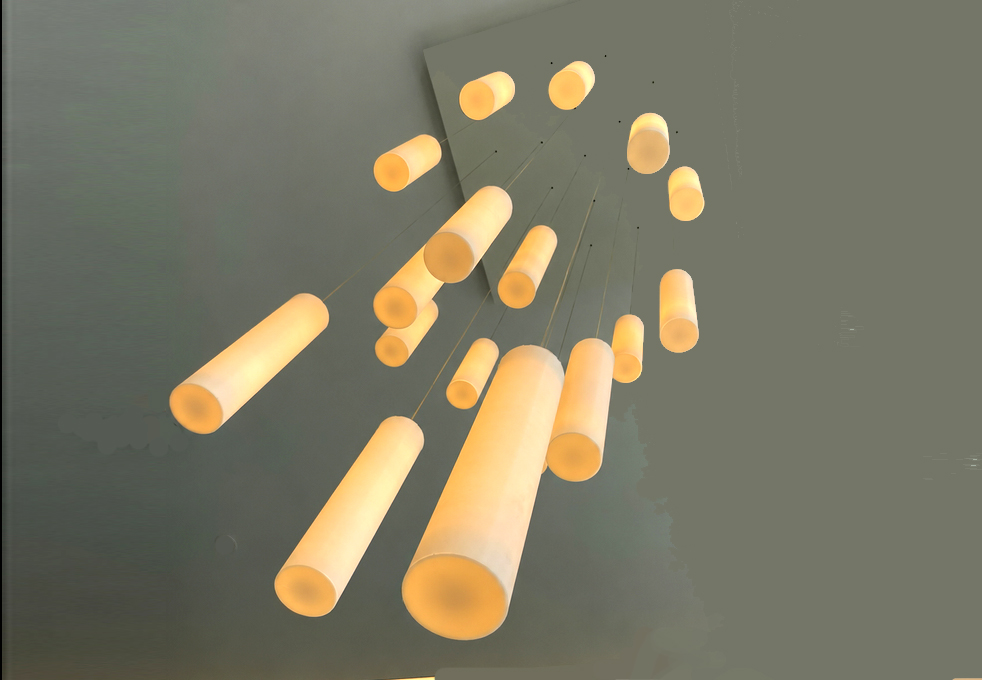
Ipswich Town Football Club has installed bespoke 3D-printed pendant luminaires made from plant-based polymers at its new training facility.
UK manufacturer LumiAdd produced a custom arrangement of opal cylindrical pendants, each suspended at a different height to create a composition specified by the interior designer.
The luminaires are manufactured using high-performance plant polymer blends, with an outer layer incorporating reclaimed scallop shell recovered from waste streams. The shell gives the surface a distinctive natural finish, replacing the need for synthetic pigments, while allowing the pendants to produce a soft, even glow.
Alongside the bespoke pendants, LumiAdd supplied its Heilis range of downlights, selected for their efficiency and circularity credentials.
The Heilis luminaires have achieved an Excellent rating under CIBSE’s TM66 Circular Economy Assessment Method for Manufacturing, the highest category available. Their embodied carbon has also been assessed under CIBSE’s TM65 methodology.
The downlights deliver up to 119 luminaire lumens per circuit watt, with a standard colour rendering index of Ra90. Available in several sizes and black or white finishes, the range includes emergency-converted versions to maintain consistency throughout the building.
All the luminaires were manufactured in the UK.
Leeds-based LumiAdd has made 3D printing with plant-based polymers central to its approach to luminaire design. The process allows products to be manufactured to order, reducing material waste while offering designers considerable freedom over shapes, finishes and dimensions.
The company has previously incorporated waste materials including reclaimed oyster and scallop shells, spent brewing grain and chocolate-production waste into its products.
It says its plant-based polymers generate 33 per cent less CO2 than petrochemical polymers and 97.5 per cent less than aluminium.
LumiAdd also operates a buy-back scheme to encourage the return of its luminaires at the end of their first life, supporting their reuse and continued circulation.
• Diary date: Circular Lighting Live 2027 takes place on Thursday 7 October 2027 in the City of London. It’s Recolight’s flagship event, comprising a two-track conference, exhibition and awards celebrating innovations in sustainable lighting.
