
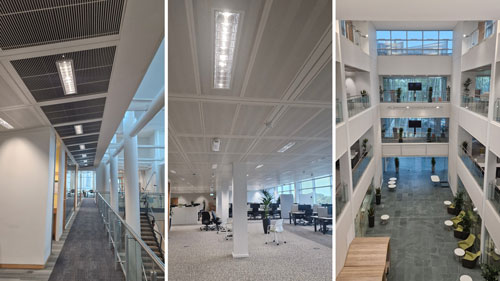
More than 8,500 existing luminaires have been remanufactured at BP’s International Centre for Business and Technology in Sunbury-on-Thames, in one of the UK’s largest commercial lighting remanufacturing projects.
Delivered by DRK Lighting across ten buildings on the campus, the project has retained approximately 30 tonnes of lighting hardware and avoided an estimated 150 tonnes of manufacturing-related CO₂ emissions. It has also reduced annual lighting energy consumption by 79 per cent, saving BP more than £1.5 million a year in energy costs.
The project addressed an ageing fluorescent installation that had become increasingly difficult and expensive to maintain. The existing fittings consumed 110W each, while four different wired lighting control systems across the estate had created compatibility problems, system failures and limited dimming capability.
Rather than remove and replace thousands of luminaires, DRK adopted a remanufacturing-first approach, retaining the original housings and upgrading their internal components. The work involved converting the 110W fluorescent systems to 21W LED, using bespoke LED boards designed to fit the existing fittings.
New drivers and intelligent controls were installed, while the original louvres were retained and cleaned using an ultrasonic process. New diffusers were also fitted to improve light distribution and occupant comfort.
The remanufactured luminaires achieve an efficacy of up to 190 lm/W, compared with approximately 81 lm/W for the original fluorescent fittings, while maintaining comparable light output.
The LED conversion delivered energy savings of more than 50%. A further reduction came from the installation of HubSense Bluetooth mesh lighting controls, incorporating PIR occupancy sensors and daylight harvesting. These allow lighting levels to respond automatically to occupancy and available natural light.
The controls deployment was reported by DRK as one of the largest single-site installations of Bluetooth smart lighting technology in Europe. The system also integrates with the existing building management system through an open API.
Work was carefully phased and carried out largely in situ, with installation scheduled out of hours where possible. This allowed approximately 75% of the office estate to remain operational during the programme, while avoiding the transport and waste associated with removing and replacing the original fittings.
According to DRK, annual lighting energy consumption fell from 6.83 million kWh to 1.46 million kWh, saving approximately 5.37 million kWh a year. The resulting reduction in operational carbon emissions is estimated at more than 1,036 tonnes of CO₂ annually.
The financial case was also significant. Avoiding complete luminaire replacement saved BP more than £600,000, while annual energy savings exceed £1.5 million. The project achieved an estimated payback period of around one year. Improvements to the emergency lighting arrangements have also reduced testing and maintenance costs, previously running at approximately £125,000 annually.
The project illustrates the potential of remanufacturing to deliver substantial energy and carbon savings without discarding serviceable lighting equipment. Rather than treating the existing luminaires as waste, BP has retained their principal structural components while bringing their performance and controls up to modern standards.
• Diary date: Circular Lighting Live 2027 takes place on Thursday 7 October 2027 in the City of London. It’s Recolight’s flagship event, comprising a two-track conference, exhibition and awards celebrating innovations in sustainable lighting.
