
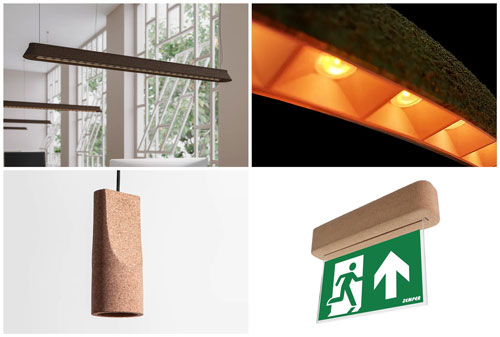
Long associated with wine bottles, flooring and noticeboards, cork is finding an increasingly prominent place in luminaire design. A growing number of manufacturers are exploring its potential as a renewable, lightweight alternative to conventional materials, with applications ranging from decorative pendants to emergency lighting.
Among the latest developments is Corkia, a new family of luminaires from UK manufacturer Thorlux and its Spanish subsidiary Zemper. Developed by the FW Thorpe group’s innovation team, the range includes cork-bodied emergency luminaires and exit signs.
Zemper says the natural cork housing of its Corkia Space recessed emergency luminaire combines a renewable material with practical performance, including IP44 protection and lithium iron phosphate batteries. The company also claims that its cork exit-sign housing has 115 per cent lower embodied carbon than a conventional polycarbonate equivalent. This is a striking claim that warrants further examination of the comparative carbon assessment.
Swedish manufacturer Zero Lighting has also extended its use of cork with Corka Linear, a 1,250mm suspended luminaire designed by Samuel Wilkinson. Made from pressed granulated cork, the fitting produces around 2,410 lumens from a 19W LED light source, with a colour temperature of 3,000K and a colour rendering index above 90. It builds on the company’s earlier Corka pendant, demonstrating how the material can be used in larger architectural lighting applications.
Portuguese manufacturer Lucecork is another company exploring cork’s potential in architectural lighting. Its approach combines aluminium with a finish incorporating natural cork granules, bringing the material into a more conventional architectural luminaire format.
The interest in cork is understandable. Harvesting the bark does not require felling the tree, and the material offers a distinctive combination of low weight, texture and renewable sourcing. Cork oak trees can continue producing bark over many decades, making the material an attractive proposition for manufacturers looking to reduce reliance on virgin plastics and other resource-intensive materials.
The challenge for lighting manufacturers will be to demonstrate that these advantages translate into durable, repairable products with credible whole-life environmental benefits. In particular, the use of cork in technical luminaires raises questions about fire performance, durability, sourcing and end-of-life recovery.
As more manufacturers experiment with natural materials, cork looks increasingly capable of moving beyond the decorative and into mainstream architectural lighting.
Cork is is harvested from the bark of trees grown mainly in Portugal and Spain. Once the bark has been removed the tree regenerates new bark over the following 15 years without being harmed. ‘Those of us old enough may recall that cork was widely used in motor engine gaskets,’ writes FW Thorpe chairman Mike Alcock in the company’s latest report. ‘There it performed reliably under demanding conditions.
‘With the wine industry in some situations moving away from virgin cork for bottle stoppers, excess raw material is available.
‘Cork components are lower cost than comparable wooden parts, and tooling costs are surprisingly modest when compared with those of plastic component manufacture.’ He says FW Thorpe is in the process of protecting the concept across the EU with suitable patent applications.
Pic, top row: Corka Linear from Zero Lighting, Lucecork. Bottom row: the Slice from Swedish manufacturer Own and Corkia from Zemper/Thorlux Lighting.
• Diary date: Circular Lighting Live 2027 takes place on Thursday 7 October 2027 in the City of London. It’s Recolight’s flagship event, comprising a two-track conference, exhibition and awards celebrating innovations in sustainable lighting.
