
Keeping existing luminaires in service, rather than replacing them, is moving from aspiration to everyday practice across the UK lighting industry.
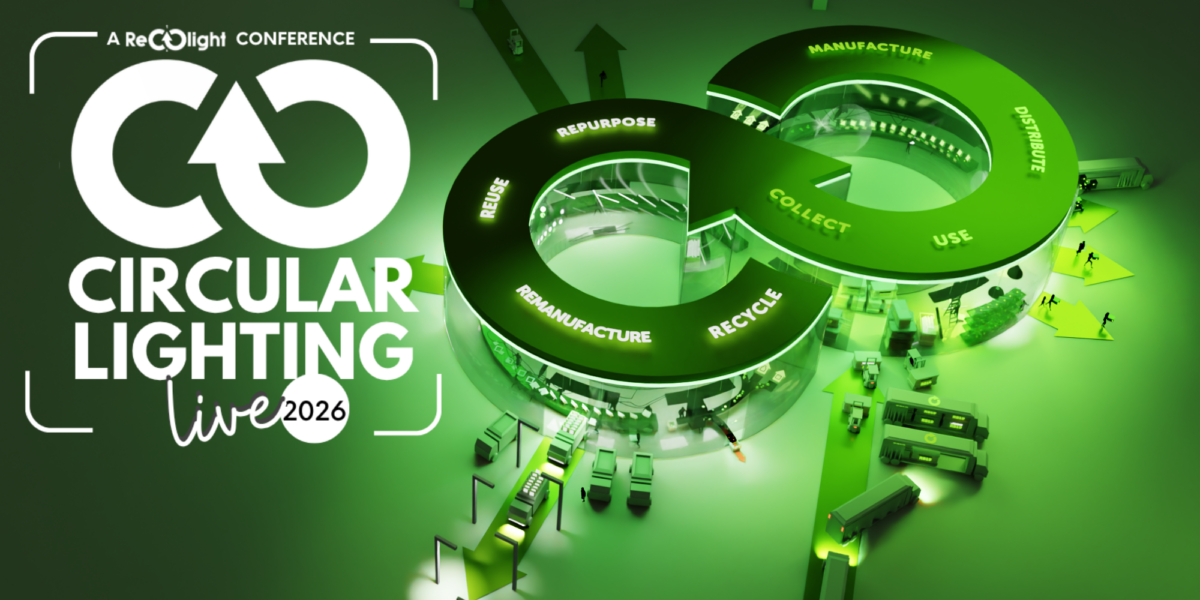
Business models built around the reuse, remanufacture and leasing of luminaires are now driving circularity in the lighting industry. That was the key message from Circular Lighting Live 2026, held in the City of London on 8 October.
Organised by Recolight, the lighting industry’s WEEE compliance scheme, the conference showcased projects where light fittings were retained and refurbished rather than replaced. Speakers were candid about both their successes and the challenges still to solve.
Beyond the next new fitting
For decades, the lighting industry has run on a simple cycle: specify, install, remove, replace. When a fit-out comes round or a light source becomes obsolete, the fittings come down and new ones go up.
Circular Lighting Live 2026 showed that cycle is now being challenged on real projects and at real scale. Remanufacture, reuse and new commercial models are moving from the margins to the mainstream.

Remanufacturing comes of age
Remanufacturing is the most mature circular approach, and it has been practised for decades. What has changed is the pressure behind it. High energy costs and the phase-out of fluorescent light sources have left many buildings with sound luminaire housings but obsolete lamps.
The projects are getting bigger. DRK Lighting presented the remanufacture of 8,000 luminaires at a commercial site, showing that circular principles work at significant scale. Conversely, at Leadenhall Market in London, Light Projects Evolve remanufactured a much smaller quantity of historic fittings and developed a bespoke LED light source to preserve the building’s Victorian character.
Reuse is harder than it looks
Recovering luminaires for reuse is not simply a matter of taking them out of a ceiling and finding a buyer. Hattie Emerson of the Finishes and Interiors Sector shared lessons from attempts to redistribute thousands of good-quality fittings removed during Cat A fit-outs. She highlighted the practical obstacles to building a working market for second-hand products.
Rethinking design and business models
Delegates heard that it is commercial arrangements that will determine if circularity will succeed or fail. Reuse, remanufacture and leasing all keep value in the product, rather than losing it when the product is replaced. Recognising that value in financial terms is important.
In his keynote address, John McRae, director of architectural practice Orms, challenged the industry to imagine a future beyond the conventional take-make-use-waste model. Sabine De Schutter, founder of Studio De Schutter, argued that reuse and upcycling can be starting points for creative lighting design rather than constraints.

Carbon, materials and regulation
Speakers examined Environmental Product Declarations (EPDs), updates to the TM66 circularity methodology, and legislation expected to put more emphasis on repairability and upgradeability. Embodied carbon looks set to sit alongside energy efficiency in every good specification.
Sessions also explored lower-impact materials and manufacturing, including bio-based plastics and robotic additive manufacturing using recycled materials.
What it means for the industry
For manufacturers, contractors, specifiers and lighting designers, the implications are practical:
- Existing luminaires should be assessed as assets before they are written off.
- Remanufactured fittings with a fresh warranty are becoming a credible option on mainstream projects.
- Clients are more likely to ask about remanufacture, EPDs and what happens to products at end of life.
- New business models and markets are emerging for lighting companies.

What the delegates said
John McRae, Director, Orms (keynote speaker):
“This year’s conference was a step change towards a more circular approach where speakers shared their innovation and lessons learned. The industry has been guilty of an addiction to selling new, but this year disassembly and take-back schemes were amongst the examples shared. The future of lighting is not brighter. It is wiser.”
Gary Thornton, Nulty:
“I think it was probably the most informative and positive Recolight conference yet. Lots of real-world examples exist, but we must continue to normalise reuse. As far as we have come, the industry is approaching a tipping point. Continue to push forward repair and regeneration rather than new at every opportunity.”
Niclas Thulin, Sustainability Manager, Fagerhult:
“If we are to increase reuse within our industry, we must start with what already exists. The requirements for reused products cannot always be identical to those for newly manufactured products. Instead, these limitations should be viewed as a catalyst for creativity, for example in lighting design.”
Sabine De Schutter, Founder, Studio De Schutter:
“For the lighting industry, moving beyond ‘buy, build, waste’ means shifting from product thinking to system thinking. One of my key takeaways was that circularity is a team sport. Conferences like this help turn shared knowledge and real examples into action.”
Mike Eddowes, Design Director, Circalume Lighting Design Practice:
“True sustainability isn’t just about designing for tomorrow; it’s about maximising the embedded carbon and potential of what we already have today. The conversation has decisively shifted from theoretical concepts to practical, scalable delivery.”
Alexander Flekler, WAGO:
“Circular Lighting Live was a truly inspiring experience. I was particularly impressed by how active the reuse and refurbishment scene in the UK lighting industry already is, with so many real projects showing that circularity is much more than just a concept.”
Matthew Thorpe, Sales Director – A&D, Fagerhult:
“An excellent forum to learn about the latest innovations and best practice in circular and sustainable [lighting]. It really felt like everyone left inspired to do more, and do better, for the planet.”
Looking ahead
Together, the presentations pointed to a shift in how the industry designs, procures and manages lighting. The direction is clear: preserve the value of what is already installed, extend its useful life, and build the commercial models that make circularity pay.
